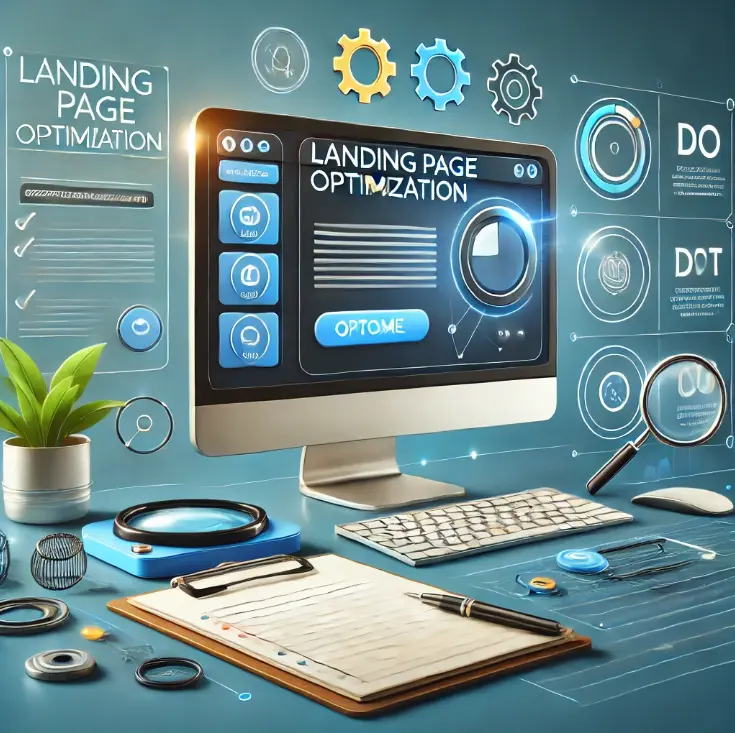
A landing page is often the first impression your potential customers have of your business. It’s powerful for converting visitors into leads or customers. Small mistakes can significantly impact its effectiveness. Avoiding common landing page optimization mistakes is key to boosting your conversions and achieving your marketing goals.
1. Ignoring Mobile Responsiveness
With mobile devices accounting for a significant portion of internet traffic, neglecting mobile responsiveness is a critical mistake. A landing page that isn’t optimized for mobile users can lead to poor user experience, slow load times, and high bounce rates.
How to Avoid This:
- Use responsive design techniques to ensure your landing page adjusts seamlessly to different screen sizes.
- Test your landing page on various devices and browsers to identify issues.
- Prioritize fast loading times by compressing images and minimizing code.
2. Overloading the Page with Information
While it’s important to provide enough information to convince users to take action, cramming too much text or too many elements onto your landing page can overwhelm visitors. This confusion often leads to abandonment.
How to Avoid This:
- Keep your message clear and concise by focusing on a single offer or call-to-action (CTA).
- Use bullet points and headers to break up content and improve readability.
- Eliminate distractions by removing unnecessary links or navigation menus.
3. Weak or Misaligned Call-to-Action (CTA)
A CTA is the heart of any landing page. A weak, unclear, or poorly positioned CTA can confuse visitors, reducing your chances of conversion. Similarly, CTAs that don’t align with the content or the visitor’s intent can drive users away.
How to Avoid This:
- Make your CTA specific and action-oriented (e.g., “Download Your Free Guide” instead of “Submit”).
- Place the CTA prominently above the fold and repeat it strategically throughout the page.
- Align the CTA with the user’s intent by ensuring the offer matches the message in your ads or emails.
4. Using Generic Headlines
Your headline is the first thing users see, and a generic or uninspiring headline can fail to grab their attention. If the headline doesn’t clearly communicate the value of your offer, visitors may leave without exploring further.
How to Avoid This:
- Craft headlines that are benefit-driven and specific (e.g., “Boost Your Sales by 50% with Our Proven Strategies”).
- Test multiple headline variations to see which performs best.
- Incorporate keywords to make the headline relevant to your audience’s needs.
5. Slow Page Loading Speed
In the digital world, speed matters. If your landing page takes more than a few seconds to load, you risk losing visitors. Slow-loading pages can also negatively affect your SEO rankings.
How to Avoid This:
- Use tools like Google PageSpeed Insights to analyze and optimize your page’s performance.
- Compress large images, use a content delivery network (CDN), and minimize server requests.
- Remove unnecessary plugins or scripts that may slow down the page.
- Lack of Trust Signals
Online users are cautious when it comes to sharing their information. Without proper trust signals, such as testimonials, security badges, or social proof, visitors may hesitate to convert.
How to Avoid This:
- Add testimonials or case studies from satisfied customers to build credibility.
- Include recognizable logos if you’ve worked with well-known brands or partners.
- Display trust badges for secure payment, data protection, or industry certifications.
7. Poor Visual Design
An unattractive or cluttered design can immediately put visitors off. Your landing page should have a clean, professional look that enhances usability and encourages action.
How to Avoid This:
- Use a consistent color scheme that aligns with your brand.
- Incorporate high-quality visuals, such as images, videos, or infographics, that support your message.
- Maintain plenty of white space to improve readability and focus attention on your CTA.
8. Failing to A/B Test
Many businesses launch their landing pages without testing different elements. This lack of optimization leaves potential conversions on the table, as you miss opportunities to refine your page based on user behavior.
How to Avoid This:
- Test key elements, such as headlines, CTAs, images, and form placements, one at a time.
- Use tools like Google Optimize, Optimizely, or Unbounce to conduct A/B tests.
- Analyze data from the tests to make informed decisions for improvement.
9. Overcomplicated Forms
Forms are a critical component of many landing pages, but asking for too much information can deter users. Long or complex forms create friction, especially for first-time visitors.
How to Avoid This:
- Keep forms as short as possible by asking only for essential information (e.g., name and email).
- Use smart forms with conditional logic to simplify the process for users.
- Add progress indicators for multi-step forms to keep users engaged.
10. Neglecting the Value Proposition
Your value proposition explains why users should choose your product or service over others. If your landing page fails to communicate this effectively, visitors may not see the benefit of converting.
How to Avoid This:
- Highlight the unique benefits of your offer clearly and prominently.
- Use bold text, icons, or visuals to draw attention to your value proposition.
- Address common objections by including FAQs or offering a guarantee.
11. Inconsistent Messaging
Landing page inconsistency occurs when there’s a disconnect between the ad or email that brought the user to the page and the content on the landing page itself. This misalignment can cause confusion and erode trust.
How to Avoid This:
- Ensure your landing page headline matches the ad copy or email subject line.
- Maintain consistent branding, such as logo placement, colors, and tone.
- Focus on delivering what the user expects based on their entry point.
12. Not Tracking and Analyzing Performance
Many businesses fail to track and analyze the performance of their landing pages, leaving them in the dark about what works and what doesn’t. Without data, improving conversions becomes guesswork.
How to Avoid This:
- Use tools like Google Analytics to monitor metrics such as bounce rate, conversion rate, and session duration.
- Set up goals to track specific actions, like form submissions or button clicks.
- Regularly review performance data to identify areas for improvement.
Conclusion
A well-optimized landing page is a cornerstone of digital marketing success. Avoiding these common mistakes can significantly enhance your page’s performance, drive conversions, and improve your ROI. Focus on creating a user-friendly experience, testing your strategies, and maintaining consistency across all touchpoints. By addressing these pitfalls, your landing pages can become powerful assets for growing your business.
FAQ and answer
- What is landing page optimization?
Landing page optimization involves improving the design, content, and structure of your landing page to increase conversions, such as sign-ups, purchases, or form submissions. - Why is landing page optimization important?
Optimizing your landing page ensures that visitors have a smooth experience and are more likely to take the desired action, ultimately boosting your conversion rates and ROI. - What are some common landing page mistakes?
Common mistakes include slow loading times, cluttered design, unclear messaging, lack of a strong call-to-action (CTA), and poor mobile optimization. - How can I improve my landing page’s conversion rate?
Simplify the design, focus on a clear CTA, ensure fast loading speeds, use persuasive copy, and test different variations (A/B testing) to find what works best. - Is mobile optimization necessary for landing pages?
Yes, mobile optimization is crucial, as many users access websites via mobile devices. A mobile-friendly landing page ensures a seamless experience across all screen sizes. - What role does A/B testing play in optimization?
A/B testing allows you to compare different versions of a landing page to see which performs better, helping you make data-driven decisions for improving conversion rates.